
Writings: Buddhism
The Khotan Dharmapada
The Khotan Dharmapada is a long birch-bark scroll with a Gandhari version of the Dharmapada, a Buddhist book of verses. It came to light near Khotan, in what is now China, in 1892, and survives in two parts, in Paris and St. Petersburg. Stefan Baums dates it probably to the second century CE.
Last reviewed:
Three dates, kept apart
The text's date: the tradition's view
each verse spoken by the Buddha on a particular occasion during his 45 years of teaching, which ended with his death in 544 BCE by the Theravada reckoning (about 589 to 544 BCE, computed here); this strip uses the Theravada account of the Pali Dhammapada for the Gandhari copy, because no statement from the Dharmaguptaka school, to which the Gandhari version is linked, was found
The text's date: critical scholars' view
Oskar von Hinuber holds that some verses may reach back to a very early period and that material was added over a long span. The sources used give no composition date for the Gandhari version.
This copy made
probably the second century CE (Stefan Baums), marked with a question mark in his table; the bar runs from 100 to 200 CE
This copy found
became known in 1892, when portions reached Dutreuil de Rhins and Grenard in Khotan; reported as found in the ruins of a monastery at the Gosrnga hill
What it is
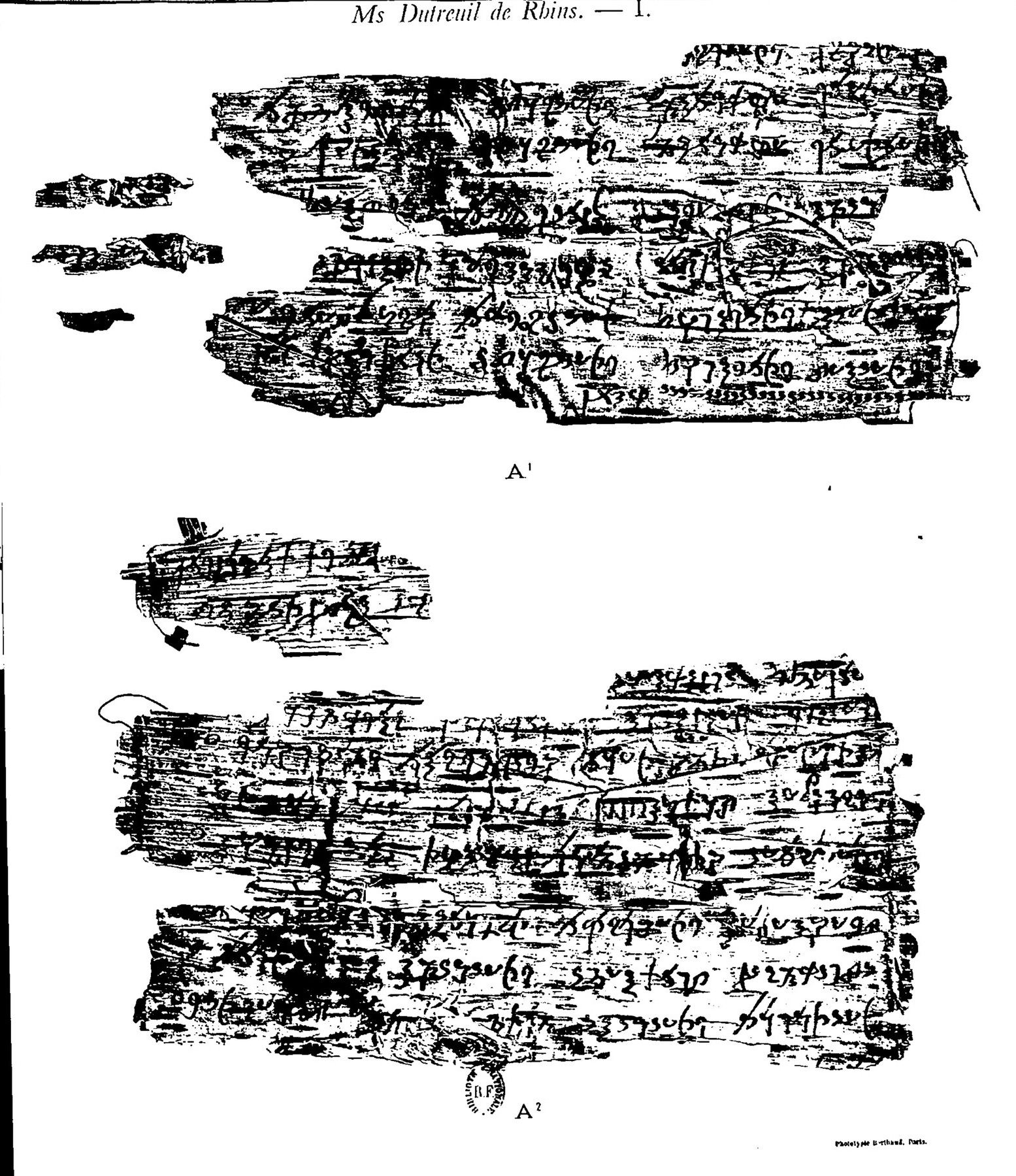
The Khotan Dharmapada is a long scroll of birch bark carrying a Gandhari version of the Dharmapada, a collection of Buddhist verses. The Pali version is the Dhammapada, with 423 verses in twenty-six chapters.1 The scroll is in the Kharosthi script. Baums estimates that it was once about 21 centimeters wide and about 5 meters long, and one scribe wrote it.2 Only about two-thirds of it survives.3 For many years it was the only substantial Gandhari manuscript known, until the finds of the 1990s.3
How the copy was dated
Baums dates the scroll probably to the second century CE, and his 2014 table of Gandharan scrolls lists the second century CE with a question mark.2 The passages read do not say what the date rests on. For the Gandharan scrolls as a group, Baums cites handwriting, language, and radiocarbon dating, which give the first and second centuries CE.2 Richard Salomon dates the Gandhari manuscripts as a group from about the first to third centuries CE.4 The sources used give no radiocarbon result for this scroll, and no rival date for it. See how ancient texts are dated.
The text: its date and authorship
The Theravada tradition's account
The Theravada tradition, the branch of Buddhism followed in Sri Lanka and Southeast Asia, teaches that each verse of the Pali Dhammapada was first spoken by the Buddha on a particular occasion, during the 45 years of teaching that ended with his death in 544 BCE by its reckoning.56 Acharya Buddharakkhita writes in the preface to a Theravada edition that a commentary by Buddhaghosa, of the fifth century CE, keeps the stories of those occasions.5 Theravada places the Dhammapada in the Khuddaka Nikaya, the collection of little texts within its canon.7 The sources used here give no statement about the Gandhari version from the Dharmaguptaka school, Mahayana, or Vajrayana.
The historians' view
In the Encyclopedia of Buddhism, Oskar von Hinuber lists the Gandhari Dharmapada as a Dharmaguptaka collection parallel to the Pali Dhammapada. He holds that the history of these collections is hard to trace, because verses were mixed and borrowed again and again. He adds that the language of some verses suggests the beginnings might reach back to a very early period, and that material was most likely added over a long span.1 Richard Salomon holds there that Gandhari versions of texts such as the Dharmapada are broadly similar to their parallels but differ significantly in structure, contents, and wording.4 The entries read give no composition date for the Gandhari version.
How it was found
The scroll became known in 1892, when portions came into the hands of Dutreuil de Rhins and Grenard in Khotan, a city on the southern Silk Road, an ancient trade route, in what is now Xinjiang, China.38 They were told that it had been found in the ruins of a vihara, a monastery, on the Gosrnga hill.9 Baums's table gives the provenance as Kohmari Mazar in Xinjiang and says the scroll lay next to a clay vessel in a cave.2 The sources used do not name who found it, and they record no excavation.
Other portions were acquired by the Russian consul-general at Kashgar, M. N. Th. Petrovskii, and sent to St. Petersburg in February 1897. Emile Senart published the Paris portions in 1898, with five reproductions of the manuscript, and Brough edited it definitively in 1962, Baums writes.93 Baums writes that the scroll is preserved partly in the Bibliotheque nationale de France and partly in the Institute of Oriental Manuscripts of the Russian Academy of Sciences in St. Petersburg.32 A scan of Senart's 1898 edition is on Wikimedia Commons.10
What it shows, and what it does not
It shows that by about the second century CE, on Baums's dating, a collection of verses like the Pali Dhammapada circulated in a second language, Gandhari.2 Salomon holds that the Gandhari and Pali versions are broadly similar but differ in structure, contents, and wording. Von Hinuber lists it beside two other parallel collections, the Patna Dharmapada and the Udanavarga. Brough concluded, with caution, that the scroll's existence implies a Gandhari canon of which it formed a part.418
It does not show that the Pali and Gandhari collections are the same book, or which came first. Von Hinuber holds that the history of these collections is obscured by mutual borrowing. It does not settle where it was found. One report names a monastery ruin at the Gosrnga hill, Baums's table names Kohmari Mazar and a cave, and the sources used record no excavation. And its date is probably, not firmly, the second century CE.192
Read next
Sources
- Oskar von Hinuber. Dhammapada. Encyclopedia of Buddhism (Macmillan Reference USA), via Encyclopedia.com, 2004. Accessed 2026-11-05.
- Stefan Baums. Gandharan Scrolls: Rediscovering an Ancient Manuscript Type. In Manuscript Cultures: Mapping the Field, edited by Jorg B. Quenzer, Dmitry Bondarev, and Jan-Ulrich Sobisch (De Gruyter), 2014, pp. 183 to 225 (section 1, section 2, Table 1, Table 2). Accessed 2026-11-05.
- Stefan Baums. Truth and Scripture in Early Buddhism: Categorial Reduction as Exegetical Method in Ancient Gandhara and Beyond. Chapter in Buddhism across Asia (author's copy; the saved text does not print the volume details), 2014, opening overview of the Gandhari manuscript discoveries. Accessed 2026-11-05.
- Richard Salomon. Gandhari, Buddhist Literature in. Encyclopedia of Buddhism (Macmillan Reference USA), via Encyclopedia.com, 2004. Accessed 2026-11-05.
- Acharya Buddharakkhita (preface and translation). The Dhammapada: The Buddha's Path of Wisdom (preface). Buddhist Publication Society, reposted by Access to Insight, preface, paragraph 2. Accessed 2026-11-05.
- John T. Bullitt. Theravada Buddhism: A Chronology. Access to Insight, 2005. Accessed 2026-10-28.
- Access to Insight. Tipitaka: The Pali Canon. Access to Insight. Accessed 2026-10-28.
- Richard Salomon. A preliminary survey of some early Buddhist manuscripts recently acquired by the British Library. Journal of the American Oriental Society 117, no. 2 (full text on the Digital Library and Museum of Buddhist Studies, National Taiwan University), 1997, pp. 353 to 358 (sections 1 to 6). Accessed 2026-11-05.
- H. W. Bailey. The Khotan Dharmapada. Bulletin of the School of Oriental and African Studies 11, no. 3, 1945, p. 488 (opening of the article). Accessed 2026-11-05.
- Emile Senart (the work scanned; uploaded to Wikimedia Commons). File: Senart, Le Manuscrit kharosthi du Dhammapada (Les fragments Dutreuil de Rhins). Wikimedia Commons, 1898, file description. Accessed 2026-11-05.