
Writings: Buddhism
The Bairat edict of Ashoka
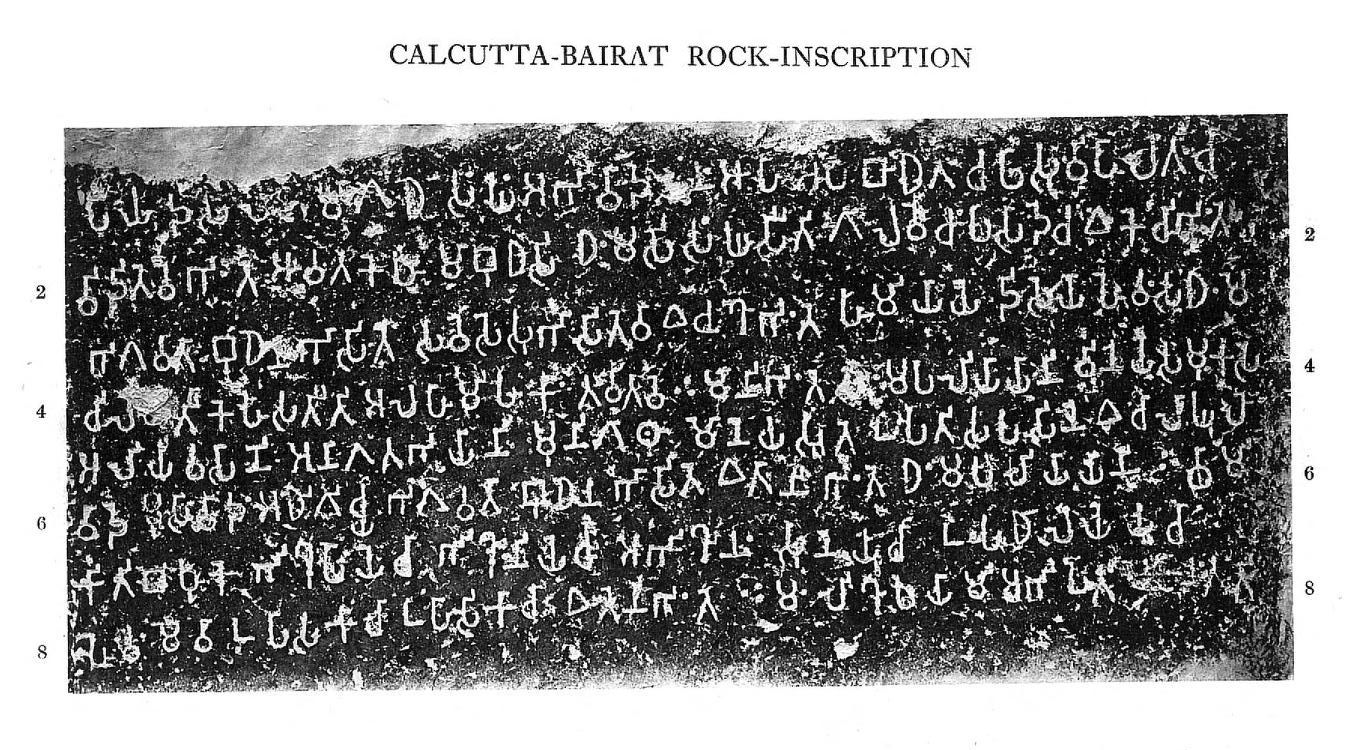
The Bairat edict is a letter from King Ashoka to the Buddhist community, cut into granite probably in the third century BCE, though no year is carved on it. It names seven teachings for monks, nuns, and lay followers to hear. A captain named Burt found it near Bairat, India, in 1840, and older sources place it in Kolkata.
Last reviewed:
Three dates, kept apart
The text's date: the tradition's view
taught by the Buddha during his 45 years of teaching, which ended with his death in 544 BCE by the Theravada reckoning (about 589 to 544 BCE, computed here); other traditions count the Buddha's dates differently
The text's date: critical scholars' view
no later than the reign of Ashoka, probably in the third century BCE (no year is carved on his edict, which names them); historians differ on the Buddha's dates (proposals from 486 to 261 BCE for his death)
This copy made
no year is carved on it; probably in the reign of Ashoka, whose monumental rock inscriptions Jens-Uwe Hartmann places in the middle of the third century BCE; Hultzsch infers the twelfth year of the reign; S. Dhammika holds that its date is not known
This copy found
found in 1840 by a captain named Burt on a hill next to the town of Bairat, in the Jaipur State of India; preserved in Calcutta by the Asiatic Society of Bengal, according to Hultzsch (1925)
What it is
The Bairat edict is a letter from a king to the Buddhist community. An edict is a ruler's public message, cut in stone. The writer calls himself Piyadasi, king of Magadha, an ancient region in what is now southern Bihar. He declares his faith in the Buddha, the Dhamma (the teaching), and the Sangha (the community of monks and nuns).12
He asks monks, nuns, and lay followers to hear seven teachings. In S. Dhammika's translation they are Extracts from the Discipline, the Noble Way of Life, the Fears to Come, the Poem on the Silent Sage, the Discourse on the Pure Life, Upatisa's Questions, and the Advice to Rahula.1 The block is grey granite, about two feet in two dimensions and a foot and a half in the third.2
How the copy was dated
No year is carved on the stone, and Dhammika holds that its date is not known.1 E. Hultzsch, in his 1925 edition of Ashoka's inscriptions, identifies the writer as Ashoka: the letter calls him a king of Magadha, and Ashoka's inscriptions match the tradition that he favored Buddhism. A find in 1915, an edict that names Ashoka, confirmed that Piyadasi was Ashoka. Hultzsch ties the reign to the Greek kings named in other edicts.21
Within the reign, Hultzsch argues that this letter seems earlier than all the other rock and pillar edicts. Its list of Buddhist texts suggests that the king was studying them after visiting the Sangha, which would put it in the twelfth year of his reign.2 Jens-Uwe Hartmann places Ashoka's monumental rock inscriptions in the middle of the third century BCE, in a general statement that does not name this edict.3 Heinz Bechert holds that most Western and Indian scholars set aside the Theravada count of 218 years from the Buddha's death to Ashoka's consecration, once exact dates for Ashoka were known.4 For the methods, see how ancient texts are dated.
The text: its date and authorship
The Theravada tradition's account
The Theravada tradition, the branch of Buddhism followed in Sri Lanka and Southeast Asia, teaches that the Buddha taught for 45 years, until his death in 544 BCE by its reckoning.56 It holds that the canon, in the Pali language, stayed oral until it was written down in Sri Lanka in the first century BCE. It also holds that Ashoka convened a third council at Pataliputra.78 It credits his son Mahinda and daughter Sanghamitta with bringing the canon to Sri Lanka.9 The sources used here for the Theravada account do not mention this edict, and no statement on the seven titles from Mahayana or Vajrayana was found.
The historians' view
Hultzsch reports that all seven texts have been traced in the Buddhist canon, citing Dharmananda Kosambi for six of them and A. J. Edmunds for the first.2 Dhammika holds in his translation notes that scholars disagree about which Pali discourses match some of the seven.1 Charles Prebish holds that the council at Pataliputra appears only in the Pali records.8 Bechert dates the Buddha's death between 420 and 350 BCE, while a 1988 symposium proposed dates from 486 to 261 BCE. On any of these dates, the edict gives a latest date for the seven teachings.4
How it was found
A captain named Burt found the block in 1840 on a hill next to the town of Bairat, in the Jaipur State of India. Hultzsch quotes Cunningham's account of the hill, called Bijak-Pahar, which means inscription hill, with ruins that Cunningham took for two Buddhist monasteries. Hultzsch's account records no excavation.2
Older books call the stone the Bhabra or Bhabru edict. To tell it from a second Bairat inscription, found in 1871 to 1872, Hultzsch called it the Calcutta-Bairat inscription.2 Hultzsch wrote in 1925 that the Asiatic Society of Bengal in Calcutta, now Kolkata, preserves the block, and Dhammika says it is housed at the Asiatic Society. Neither gives a catalog number, and the present holder was not confirmed from a current source.21
What it shows, and what it does not
It shows that a king of Ashoka's reign, probably in the third century BCE, stated his faith in the Buddha, the Dhamma, and the Sangha, and asked the community to hear seven teachings known by title. In the letter he writes: Whatever, reverend sirs, has been spoken by Lord Buddha, all that is well-spoken.
1 He names the last of the seven, the Advice to Rahula, as spoken by the Buddha concerning falsehood.21
It does not show that the seven teachings were written down: the king asks monks and nuns to listen to them, and the stone gives titles, not texts.1 It does not show that they read as the Pali versions do, since scholars disagree on which discourses match some titles.1 Oskar von Hinuber holds only that some titles probably refer to Sutta-nipata texts.10 And it does not fix the Buddha's dates, only a latest date for the teachings.4
Read next
Sources
- S. Dhammika. The Edicts of King Asoka: An English Rendering. Buddhist Publication Society, Wheel Publication 386/387, reposted by Access to Insight, introduction; Minor Rock Edicts, third edict, and notes 36 to 38. Accessed 2026-11-05.
- E. Hultzsch. Inscriptions of Asoka, new edition (Corpus Inscriptionum Indicarum, vol. 1). Clarendon Press, Oxford, for the Government of India, 1925, introduction pp. xxv, xxx to xxxi, xxxv to xxxvi, xliii, xlvii; text, translation, and notes on the Calcutta-Bairat inscription, pp. 172 to 174. Accessed 2026-11-05.
- Jens-Uwe Hartmann. The Schoyen Collection in Context (introduction to Traces of Gandharan Buddhism: An Exhibition of Ancient Buddhist Manuscripts in the Schoyen Collection, by Jens Braarvig and Fredrik Liland). Hermes Publishing, Oslo, 2010, p. xxvi. Accessed 2026-11-05.
- Heinz Bechert. Buddha, Life of the. Encyclopedia of Buddhism (Macmillan Reference USA), via Encyclopedia.com, 2004. Accessed 2026-10-28.
- Paul Harrison. Canon. Encyclopedia of Buddhism (Macmillan Reference USA), via Encyclopedia.com, 2004. Accessed 2026-10-28.
- John T. Bullitt. Theravada Buddhism: A Chronology. Access to Insight, 2005. Accessed 2026-10-28.
- Lewis R. Lancaster. Buddhist Books and Texts: Canon and Canonization. Encyclopedia of Religion, 2nd ed. (Macmillan Reference USA), via Encyclopedia.com, 2005. Accessed 2026-10-28.
- Charles S. Prebish. Councils, Buddhist. Encyclopedia of Buddhism (Macmillan Reference USA), via Encyclopedia.com, 2004. Accessed 2026-10-28.
- Kate Crosby. Theravada. Encyclopedia of Buddhism (Macmillan Reference USA), via Encyclopedia.com, 2004. Accessed 2026-10-28.
- Oskar von Hinuber. Pali, Buddhist Literature in. Encyclopedia of Buddhism (Macmillan Reference USA), via Encyclopedia.com, 2004. Accessed 2026-10-28.