
Writings: Buddhism
The Diamond Sutra of 868 CE
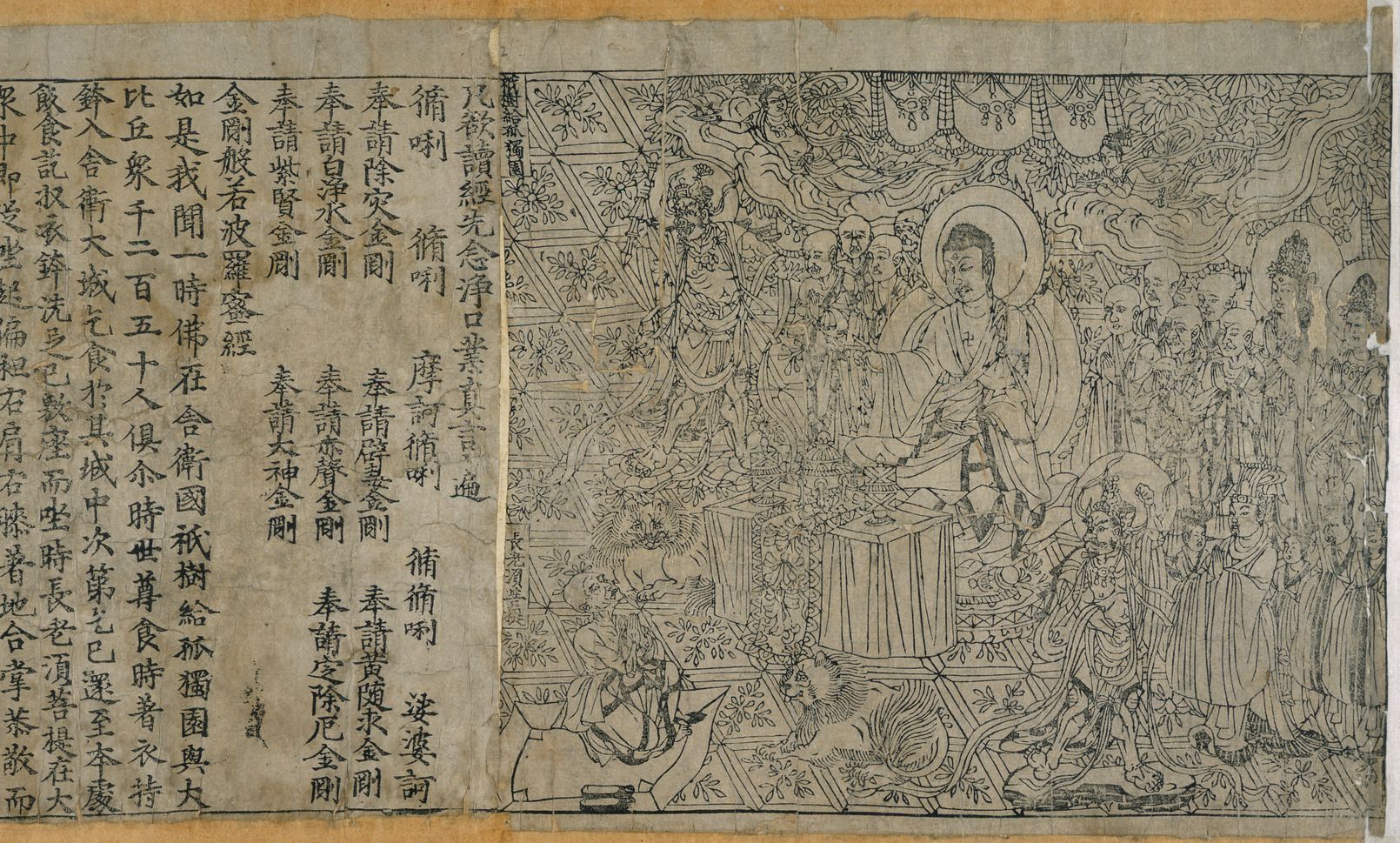
The Diamond Sutra of 868 CE is a Buddhist scripture printed from carved wooden blocks onto a scroll about 16 feet long. Its closing note carries a date that converts to 11 May 868 CE. The British Library calls it the earliest complete printed book with a date. Aurel Stein bought it at Dunhuang, China, in 1907.
Last reviewed:
Three dates, kept apart
The text's date: the tradition's view
The Tibetan and Zen accounts consulted (the second turning, the Jeta Grove setting) give no date for the Sanskrit sutra, which is what the strip marks. The translation project 84000's history section adds that there are reasons for suspecting the Diamond Cutter may date to as early as the second century CE.
The text's date: critical scholars' view
the second or the fourth century CE, with arguments made for each (Gregory Schopen)
This copy made
11 May 868 CE, as the date printed in the scroll's closing note converts
This copy found
the cave found in 1900 by Wang Yuanlu; this scroll bought there by Aurel Stein in 1907
What it is
The Diamond Sutra, in Sanskrit the Vajracchedika, is a short scripture of Mahayana, the "Great Vehicle" of Buddhism. It is counted among the Perfection of Wisdom sutras, and its title can be read as the perfection of wisdom that cuts like a thunderbolt.12 The British Library calls it one of the most influential Mahayana sutras in East Asia, and Schopen writes that Chinese Chan schools gave it an important place.31
This copy is a Chinese edition printed from carved wooden blocks. A picture of the Buddha, called a frontispiece, opens the scroll. The text follows on seven sheets of paper glued into a roll about 16 feet long. The whole text survives, which Linda Hall's note counts as part of what makes it special.4
How the copy was dated
The scroll dates itself. It ends with a note called a colophon, which says that Wang Jie had it made for universal distribution on behalf of his two parents, in the ninth year of the Xiantong reign period. That converts to 11 May 868 CE.4 Melodie Doumy, the British Library's lead curator of Chinese collections, gives the same year and says the colophon names Wang Jie as the one who commissioned it.5 The British Library describes it as the earliest complete printed book with a date.3
The method is therefore reading a date printed in the object itself, not comparing handwriting or testing the paper. The sources used here report no scientific test of the paper and no dispute over the date. The date is that of this printing, and the sutra's own date is a separate question. For the methods, see how ancient texts are dated.
The text: its date and authorship
The date strip marks the Sanskrit sutra, not this print.
Tibetan and Zen accounts
The translation project 84000 holds that Mahayana tradition counts the Perfection of Wisdom sutras as teachings from the Buddha's second turning of the wheel of Dharma. It sets the Diamond Cutter, its title for this sutra, at the Jetavana in Shravasti. It calls the sutra a relatively succinct summary of selected key points of the longer works, much read and recited, and the subject of several commentaries. Its history section adds that there are reasons for suspecting the sutra may date to as early as the second century CE.2
Plum Village, the community of Thich Nhat Hanh, a Zen teacher ordained in Vietnam, presents the sutra as a discourse the Buddha gave to his disciple Subhuti in the Jeta Grove near Shravasti. It opens as a report of what a hearer heard, among a community of 1,250 monks. Plum Village publishes his translation from the Sanskrit and from the Chinese Taisho edition numbered 235.67 Neither Plum Village page gives a date.
The historians' view
Gregory Schopen holds that the date of the sutra in Sanskrit is uncertain, with arguments made for the second and for the fourth century CE. He notes that it was first translated into Chinese at the very beginning of the fifth century, when Vasubandhu and Asanga, who probably lived in the fourth or fifth century, had already written commentaries on it.1
Paul Harrison, in the introduction to his translation, argues that it is probably an early text. He reads wordplay that the Sanskrit copies have obscured as pointing to a presumed earlier form in Prakrit, a Middle Indic dialect.89 In an encyclopedia entry, he holds that Buddhists could accept a teaching as the word of the Buddha if it was meaningful, accorded with the dharma, and led toward liberation. He adds that some came to accept the Mahayana sutras this way.9
How it was found
The scroll came from the Library Cave, also called Mogao Cave 17, near Dunhuang in northwest China. The chamber held tens of thousands of manuscripts, printed items, and paintings, and it had been sealed for nearly 900 years.3 The reason it was sealed is not known.5 A Daoist priest named Wang Yuanlu found the cave in 1900.5 In 1907 the archaeologist Aurel Stein visited Dunhuang and bought many manuscripts from it, among them the Diamond Sutra.45
That was a purchase, not an excavation, and the sources used here give no record of where in the cave the scroll lay. It is now in the British Library in London, as Or.8210/P.2.10
Views of the sale differ. Linda Hall's note says that Western historians are not sure how to view Stein, and that Chinese historians have mixed feelings about Wang, who sold much of the cave's contents to foreigners.4 Erica Eisen, in a London Review of Books blog post, writes that in China, Stein is widely regarded as a thief.
11 The sources used here include no statement from the Dunhuang Academy or a Chinese Buddhist body on his purchase.
Doumy calls Stein's visit the start of the large-scale dispersal of the cave's contents, and says in 2024 that the British Library's International Dunhuang Programme links the collections of more than 35 institutions online, among them the Dunhuang Academy and the National Library of China.5
What it shows, and what it does not
Doumy says the refined design and craftsmanship of the scroll attest to a significant advance in printing technology.5 Linda Hall's note adds that sutras were printed from carved blocks in China by the late 7th century. What sets this scroll apart is that it is complete and precisely dated.4 Eisen, in the same blog post, writes that copying a sutra on the scale printing allowed was believed to increase the chances of a happy rebirth for oneself or loved ones.11 The translation project 84000 holds that many Perfection of Wisdom sutras, the group this sutra belongs to, extol the merits of writing them out and reproducing them as books.2
It does not show when the sutra was composed or first translated. Schopen dates the first Chinese translation to the start of the fifth century. Harrison dates Sanskrit copies from Gilgit, and from a Schoyen Collection manuscript presumed to come from Afghanistan, to about the 6th to 7th century on handwriting. Both are earlier than this print.18 It does not show that printing began in 868, since earlier printing is known.4 Where it was printed is suggested, not certain: Doumy says scholars have suggested it was probably made in Sichuan, a main printing center of the time.5 The sources used here do not say which Chinese translation this scroll carries.
Read next
Sources
- Gregory Schopen. Diamond Sutra. Encyclopedia of Buddhism (Macmillan Reference USA), via Encyclopedia.com, 2004. Accessed 2026-11-05.
- 84000 Translating the Words of the Buddha. Perfection of Wisdom (Kangyur section overview). 84000, Overview; Themes, Narratives, Style, and Significance; history of the texts. Accessed 2026-10-28.
- British Library. A Silk Road Oasis opens at the British Library (press release). British Library, 2024. Accessed 2026-11-05.
- William B. Ashworth Jr.. The Diamond Sutra (Scientist of the Day, May 11, 2023). Linda Hall Library of Science, Engineering and Technology, 2023. Accessed 2026-11-05.
- The Art Newspaper (interview with Melodie Doumy, lead curator of Chinese collections at the British Library). The world's oldest printed book and rare ancient manuscripts from the Mogao caves in China to go on show in London. The Art Newspaper, 2024. Accessed 2026-11-05.
- Plum Village (Thich Nhat Hanh's translation). The Diamond That Cuts through Illusion (sutra text). Plum Village Community of Engaged Buddhism. Accessed 2026-11-05.
- Plum Village. Thich Nhat Hanh. Plum Village. Accessed 2026-10-28.
- Paul Harrison. Vajracchedika Prajnaparamita, A New English Translation of the Sanskrit Text Based on Two Manuscripts from Greater Gandhara. Buddhist Manuscripts, volume III (Manuscripts in the Schoyen Collection), ed. Braarvig and others (Hermes Publishing, Oslo), 2006, pp. 133 to 141 (the introduction). Accessed 2026-11-05.
- Paul Harrison. Canon. Encyclopedia of Buddhism (Macmillan Reference USA), via Encyclopedia.com, 2004. Accessed 2026-10-28.
- J. Paul Getty Trust. The Diamond Sutra: A Story of Printing, Piety and Preservation on the Silk Road (lecture listing). Getty Center, Los Angeles. Accessed 2026-11-05.
- Erica Eisen. The Oldest Printed Book in the World. London Review of Books blog, 2018. Accessed 2026-11-05.