
Writings: Christianity
The Muratorian Fragment
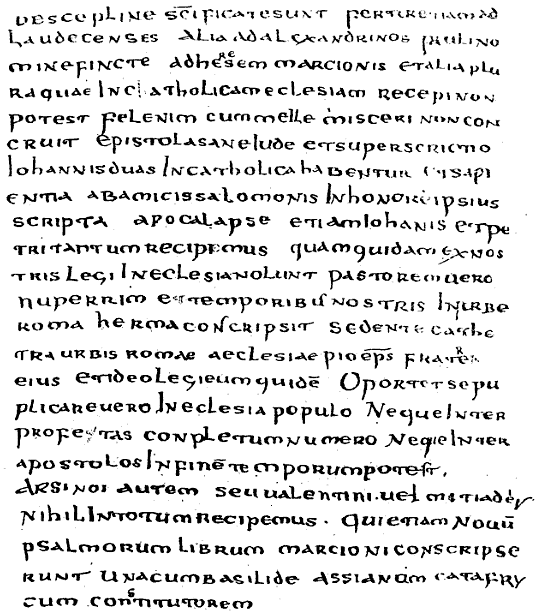
The Muratorian fragment is a damaged Latin list of New Testament books, copied into a codex of the eighth century CE, or possibly the seventh, that is now in Milan. Scholars date the list itself to the late second century or to the fourth century, and the question is still debated.
Last reviewed:
Three dates, kept apart
The text's date: the tradition's view
The beginning of the list is lost and its writer is unknown, and the sources consulted record no church teaching about its writer or date.
The text's date: critical scholars' view
the end of the second century CE or the start of the third (one summary gives about 170 CE), or the fourth century CE; scholars disagree
This copy made
eighth century CE, or possibly the seventh
This copy found
identified by Lodovico Antonio Muratori in the Ambrosian Library, Milan, in 1700; published in 1740
What it is
The Muratorian fragment is a list of New Testament books, written in Latin. Its beginning and probably its end are lost, and what survives runs to 85 lines.1 A list of books a church accepts as scripture is called a canon. This one names Luke as the third Gospel and John as the fourth. It also lists Acts, thirteen letters of Paul, Jude, two or possibly three letters of John, and Revelation.23
It accepts the Wisdom of Solomon, and it says the Shepherd of Hermas may be read but not before the people in church.3 The Latin is poorly copied, and most scholars have thought it translates a Greek original.2 Its main copy is part of a codex, a bound book, in Milan.1
How the copy was dated
The list survives in one main copy: a codex of 76 leaves of coarse parchment, held in the Ambrosian Library in Milan.1 Albert Sundberg describes the codex as dating from the eighth century or possibly the seventh, and as having belonged to Columban's monastery at Bobbio.4 One summary of the list gives the seventh century for the codex.3 The sources consulted do not say how the codex was dated. Four Latin manuscripts of Paul's letters from the eleventh or twelfth century, at Monte Cassino, hold bits of the same list, drawn from a source other than the Milan codex.4
The date of the list itself is a separate question, and the disputed one; the next section sets it out. See how ancient texts are dated for the methods behind both dates.
The text: its date and authorship
The tradition's account
The beginning of the list is lost and its writer is unknown, and the sources consulted record no church teaching about its writer or date.14
Churches do teach about how the list of scripture was settled. Catholic teaching holds that the Church discerned, by apostolic tradition, which writings belong in the list of sacred books.5 The Westminster Confession, a Reformed Protestant statement, holds that the Bible's authority depends on God, not on any church.6 The Orthodox Church in America holds that the Bible was produced in the Church, by and for the Church.7 The list itself reports that its church receives the Gospels, Acts, Paul's letters, and a few other books, and that some members will not allow the Apocalypse of Peter to be read in church.23
The historians' view
Muratori assigned the list to Caius, a presbyter in Rome, and later scholars have suggested Papias, Hegesippus, Rhodon, and Melito of Sardis.4
Scholars have long dated the list to the end of the second century or the start of the third.2 C. E. Hill, in a 1995 review article, holds that the list's statement that Hermas wrote the Shepherd very recently, while Pius was bishop of Rome, is probably the single greatest difficulty for a later date.83 Albert Sundberg (1973) and Geoffrey Hahneman (1992) hold that it belongs with the fourth-century lists, and Peter Head doubts that Hahneman established that date.429
Dale Martin of Yale says scholars tend to line up on one side or the other. He says most used to put it around 200 CE, and that he understands most scholars would probably now say later. He gives no survey.10
How it was found
Lodovico Antonio Muratori, an archivist and librarian from Modena, found the list in 1700 in a manuscript in the Ambrosian Library in Milan, and published it in 1740.1 The manuscript had belonged to the monastery at Bobbio, as its ownership note shows.1 No source consulted says when it moved from Bobbio to Milan.
The text Muratori printed was a poorly copied Latin one, and he suggested that the list was first written in Greek. That suggestion has received wide support, though some scholars have argued for a Latin original.4
What it shows, and what it does not
The list shows that someone wrote down which books its writer said the church accepted, allowed to be read, or turned away. The books it names include four Gospels, thirteen letters of Paul, and Revelation; it accepted the Apocalypse of Peter with reservations and kept the Shepherd of Hermas out of public reading.32 If the second-century date holds, it is the oldest known list of New Testament books.13
It does not show what any church decided, since it records one writer's list. It does not show when churches agreed on the 27 books that most churches now count. The earliest surviving list that matches them is Athanasius's letter of 367 CE.10 And it does not settle its own date, which scholars place in the late second century or in the fourth. If the fourth-century date holds, it stands with that century's Eastern lists.24
Read next
Sources
- Eckhard J. Schnabel. The Muratorian Fragment: The State of Research. Journal of the Evangelical Theological Society 57:2, 2014, pages 231 to 232. Accessed 2026-11-05.
- C. E. Hill. The Debate over the Muratorian Fragment and the Development of the Canon. Westminster Theological Journal 57:2, 1995, pages 437 to 438. Accessed 2026-11-05.
- Translation by Bruce M. Metzger, with notes by the site editor. The Muratorian Fragment. Bible Research (bible-researcher.com). Accessed 2026-11-05.
- Albert C. Sundberg Jr.. Canon Muratori: A Fourth-Century List. Harvard Theological Review 66:1, 1973, opening extract, page 1. Accessed 2026-11-05.
- Catholic Church. Catechism of the Catholic Church, paragraphs 120 to 130: The Canon of Scripture. Libreria Editrice Vaticana, paragraph 120. Accessed 2026-10-28.
- Westminster Assembly. The Westminster Confession of Faith. The Orthodox Presbyterian Church, chapter 1. Accessed 2026-10-28.
- Thomas Hopko. The Orthodox Faith, Volume I: Doctrine and Scripture, The Bible: Interpretation. Orthodox Church in America. Accessed 2026-10-28.
- C. E. Hill. The Debate over the Muratorian Fragment and the Development of the Canon. Westminster Theological Journal 57:2 (copy on the Gospel Studies site, gospelstudies.org.uk), 1995, pages 438 to 439 (the argument about the Shepherd of Hermas) and footnote 2. Accessed 2026-11-05.
- Peter M. Head. Review of Geoffrey Mark Hahneman, The Muratorian Fragment and the Development of the Canon (Oxford Theological Monographs, Clarendon Press, 1992). Themelios 21:3 (The Gospel Coalition archive). Accessed 2026-11-05.
- Dale B. Martin. Introduction to New Testament History and Literature (RLST 152), Lecture 2: From Stories to Canon. Open Yale Courses, Yale University, transcript. Accessed 2026-10-28.