
Writings: Judaism
The Nash Papyrus
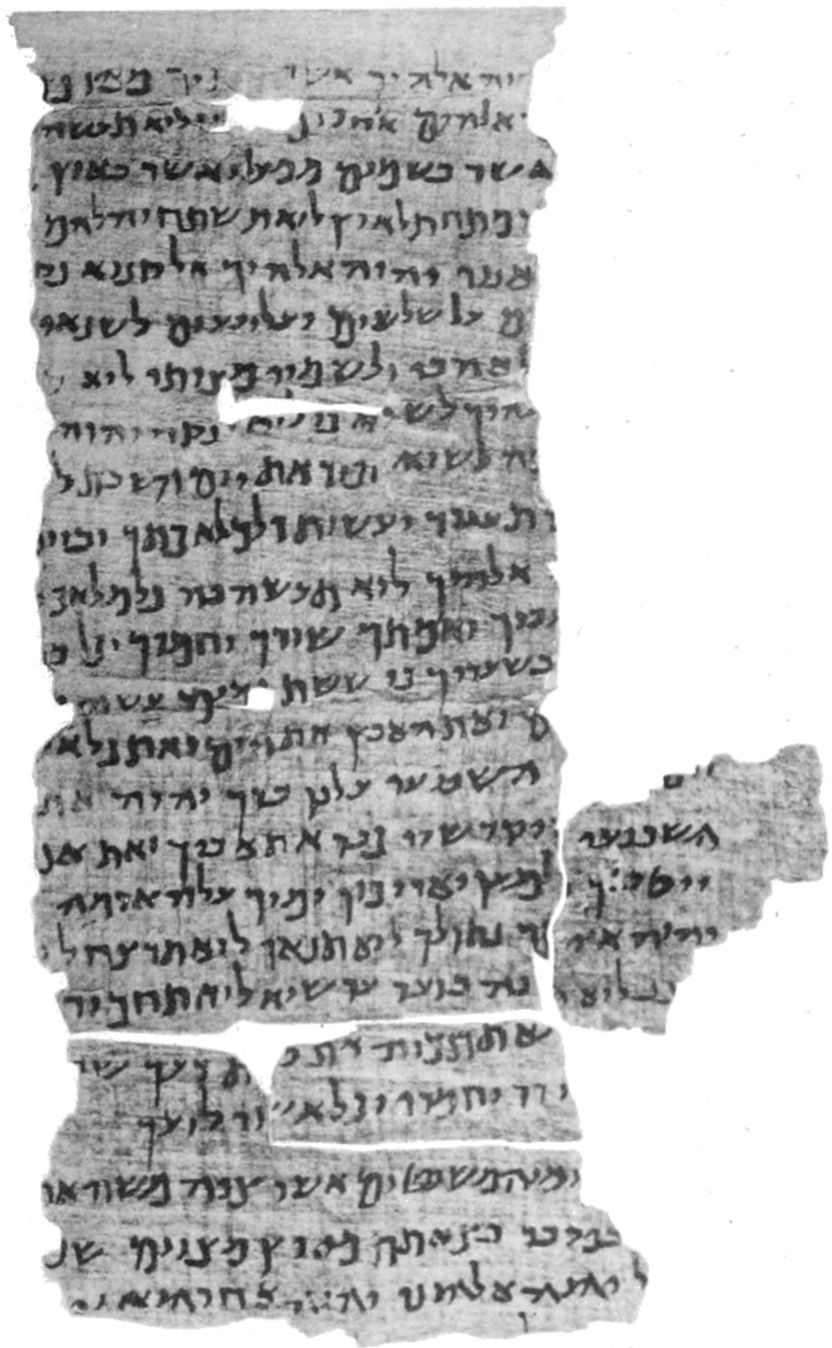
The Nash Papyrus is four joined fragments of Hebrew papyrus in Cambridge University Library. It holds the Ten Commandments in a form that mixes Exodus and Deuteronomy, followed by the start of the Shema. The usual dating, by handwriting, is the second century BCE; Cook, Burkitt, and Kahle placed it in the first or second century CE.
Last reviewed:
Three dates, kept apart
The text's date: the tradition's view
about 1300 BCE, for the giving of the Torah at Sinai, which holds the Ten Commandments and the Shema (the Orthodox Union, an Orthodox body, is the only source consulted that puts a time on it, writing that God gave the Torah at Sinai "some thirty three hundred years ago" on a glossary page stamped June 21, 2006; the BCE year is computed here from that phrase and the stamp, which may be a load date, and an earlier writing date would move the figure by years, not centuries; the Orthodox Union's entry on the Tanakh, the Conservative statement Emet Ve-Emunah (1988), and the Central Conference of American Rabbis' statements of 1976 and 1999 give no year)
The text's date: critical scholars' view
about the 10th century BCE to the 3rd century BCE, for the Torah's sources, among them the Exodus and Deuteronomy passages with the Decalogue and the Shema (this site's reading of Christine Hayes of Yale in a lecture: she calls the documentary hypothesis, the proposal that hypothetical source documents lie behind the Torah's text, a major hypothesis that is not without criticism, and useful; she says most biblical scholars accept some version of it, with less confidence in its finer details, and that its sources are assigned relative dates, not absolute dates; she reports that source critics dated the earliest source, J, to about the 10th century BCE and that other scholars date all of it after the fifth century BCE, in the fourth or third; for the passages here she says the Exodus laws tend to be dated to the tenth and ninth centuries BCE in written form and Deuteronomy's laws, with the Decalogue in chapter 5 and the Shema in chapter 6, to the eighth to the sixth century, its core to the late seventh; the tradition's bar marks the giving of the Torah at Sinai and this bar the writing of its sources)
This copy made
second century BCE, the usual dating of when the papyrus was written (W. F. Albright, 1937; the library's record says it is thought to date from then); first century CE on Francis Burkitt's and Paul Kahle's dating and second century CE on Stanley Cook's; the strip marks 200 to 101 BCE, the span of the usual century, computed here
This copy found
1898 or 1902, when the papyrus was bought in Egypt (the sources disagree; W. L. Nash bought it from a dealer and it is said to have come from the Fayyum; it was presented to Cambridge University Library in 1903)
What it is
The Nash Papyrus is a small Hebrew sheet of papyrus, a writing material made from the papyrus plant. It survives as four fragments fixed together on card.1 It holds the Ten Commandments, also called the Decalogue, followed by the opening of the Shema, the prayer that begins with the call for Israel to hear that the Lord is one (Deuteronomy 6:4-5).2 Most of twenty-four lines survive, with traces of a twenty-fifth.1 The Decalogue is a mixed form of Exodus 20 and Deuteronomy 5. On discovery it was proclaimed the oldest Hebrew manuscript of any kind in existence, Cambridge University Library's record says, citing Cook's publication of 1903.2
How the copy was dated
Dating rests mainly on handwriting, though Cook and Burkitt also weighed the wording and spelling; the sources used report no radiocarbon test.31 The usual date is the second century BCE, Brent Nongbri writes, on the basis of paleography. W. F. Albright proposed it in 1937, in an article that moved the date from the second century CE.4 The library's record says it is thought to date from then, citing Albright, and Emanuel Tov dates it the same way.25
Rival datings, among them the first editors', put it in the first or second century CE. Cook concluded in 1903 that the handwriting allowed the second century CE, probably its first quarter.3 Francis Burkitt compared the letters with a Nabataean inscription of 55 CE and inclined to about that date, and the library's report of 1903 said probably the first century CE.12 Paul Kahle also dated it to the first century CE, as J. A. Sanders wrote in 1967.6
Greek fragments of the Odyssey came with it, dated by two papyrologists to 50 to 150 CE; one, H. Idris Bell, doubted they bear on the papyrus's date, since dealers combine unrelated pieces.4 See how ancient texts are dated.
The text: its date and authorship
The strip marks the Decalogue and the Shema as they stand in the Torah, the first five books of the Tanakh, the Hebrew Bible.7 The tradition's bar, about 1300 BCE, marks the giving of the Torah at Sinai and is computed here from the Orthodox Union's wording, the only one consulted with a time. The scholars' bar is this site's reading of Hayes's range for the Torah's sources, the 10th to the 3rd century BCE.
The tradition's view
The Orthodox Union's entry on the Torah, posted in 2006, says God gave the Torah at Sinai some 3,300 years ago, and teaches that the Ten Commandments and the whole text of the Five Books of Moses are of divine origin. It describes tefillin, boxes worn on the arm and forehead that hold parchments with verses including the Shema. An Orthodox Union entry on the Tanakh teaches that Moses received every word of the Torah as dictation from Heaven.87
Emet Ve-Emunah, the Conservative statement of 1988, describes several views of revelation, from God speaking in actual words to an ongoing discovery of truths about God.9 The Central Conference of American Rabbis' statement of 1999 calls Torah God's ongoing revelation, and its statement of 1976 holds that Torah results from the relationship between God and the Jewish people.1011 None of the three gives a year.
The Mishnah has priests reciting the Ten Commandments and the Shema in the Temple, and the Talmud says reciting the Ten Commandments outside the Temple was abolished because of the heretics, who, the William Davidson edition explains, argued that only the Ten Commandments came from God.1213
Scholars of the Torah: Hayes, Brettler, and Weinfeld
Christine Hayes says in a lecture that the Pentateuch holds three versions of the Decalogue, in Exodus 20, Deuteronomy 5, and Exodus 34. She reports that Marc Brettler holds that ancient Israel did not strive to preserve sacred texts word for word. She says the Exodus laws tend to be dated to the tenth and ninth centuries BCE in written form, and Deuteronomy's laws to the eighth to the sixth century.14
She reports that Moshe Weinfeld and others hold that Deuteronomy's core emerged in the eighth century, and that Josiah's reform of about 622 BCE gives a basis for dating that core to the late seventh. She calls the Shema a central expression of love of God, part of Jewish liturgy from a very early stage.15 She says most biblical scholars accept some version of the documentary hypothesis, the proposal that hypothetical source documents lie behind the Torah's text, with less confidence in its finer details, and that its sources are assigned relative dates, not absolute dates.16
How it was found
W. L. Nash, secretary of the Society of Biblical Archaeology, got the papyrus from a dealer in Egypt, together with fragments of Homer's Odyssey. He thought the whole find probably came from the Fayyum, in Middle Egypt.117 Nongbri quotes the library's current page as saying the fragment was said to have come from the Fayyum.18
The year is uncertain. Burkitt's account of 1903, in The Cambridge Review, says Nash received the fragments in the course of 1902, as Nongbri quotes it, and Esther Eshel gives 1902 too.1917 Other accounts give 1898, which Nongbri could not trace to any record made at the time, and Tov wrote in 2020 that it was bought in either year.186 Nash gave the papyrus to the library in 1903.2
What it shows, and what it does not
It shows the Decalogue followed by the Shema, in wording that blends Exodus and Deuteronomy, and in places agrees with the Septuagint, the Greek translation.21 Eshel holds that none of the three oldest copies of the Decalogue, this papyrus among them, matches the Masoretic Text, the standard Hebrew text of the Tanakh.17 Burkitt conjectured it held a pious Egyptian Jew's daily worship.1
A reference work says the papyrus apparently is not from a Bible scroll but from a collection of texts for liturgical or educational use.20 The library says the mixed wording may reflect a fluid text or copying from memory, and that it may come from a phylactery (tefillin), a ritual object used in daily prayer; Eshel allows that it may be a mezuzah, a doorpost scroll.217 Burkitt judged the Masoretic Text of the Decalogue the more archaic, and the papyrus popular religion.1 It does not settle its own date, which depends on the dispute above, or exactly where it was found, which the sources give as Nash's judgment.
See also
Read next
Sources
- F. C. Burkitt. The Hebrew Papyrus of the Ten Commandments. Jewish Quarterly Review 15 (1903), pp. 392 to 408 (the April 1903 issue, from the Internet Archive's full-text scan), 1903, pp. 392 to 408; the passages on p. 392 (the find), p. 394 (the fragments), pp. 398 to 403 (liturgy, the Septuagint, the date), and p. 402 (Burkitt's own view of the text). Accessed 2026-11-06.
- Cambridge University Library (Cambridge Digital Library record). Hebrew Manuscripts: Nash Papyrus (MS Or.233). Cambridge University Library, the record's description. Accessed 2026-11-06.
- S. A. Cook. A Pre-Massoretic Biblical Papyrus. Proceedings of the Society of Biblical Archaeology 25 (1903), pp. 34 to 56 (from the Internet Archive's full-text scan of volume 25), 1903, the paleography section on pp. 48 to 51. Accessed 2026-11-06.
- Brent Nongbri. A Cambridge Papyrus of the Odyssey and the Nash Papyrus. Brent Nongbri's blog (August 3, 2026), 2026, the whole post. Accessed 2026-11-06.
- Emanuel Tov. Scribal Practices and Approaches Reflected in the Texts Found in the Judean Desert. Brill, Leiden, 2004; the book as posted on Tov's website, 2004, the note on the Decalogue and the Nash papyrus in the chapter on tefillin and mezuzot (the note numbered 331 in the file), and the spacing note nearby. Accessed 2026-11-06.
- Brent Nongbri. The Purchase of the Nash Papyrus, Again. Brent Nongbri's blog (August 5, 2026), 2026, the whole post. Accessed 2026-11-06.
- Orthodox Union. Tanakh (Judaism 101 glossary). Orthodox Union, glossary entry. Accessed 2026-10-29.
- OU Staff. Torah. Orthodox Union, 2006. Accessed 2026-10-29.
- Commission on the Philosophy of Conservative Judaism. Emet Ve-Emunah: Statement of Principles of Conservative Judaism. The Jewish Theological Seminary of America, The Rabbinical Assembly, and The United Synagogue of America, 1988, printed pages 18 to 26. Accessed 2026-10-29.
- Central Conference of American Rabbis. A Statement of Principles for Reform Judaism. Central Conference of American Rabbis, 1999, Torah. Accessed 2026-10-28.
- Central Conference of American Rabbis. Reform Judaism: A Centenary Perspective. Central Conference of American Rabbis, 1976, section 3, Torah. Accessed 2026-10-28.
- Mishnah (William Davidson Edition, English). Mishnah Tamid 5:1. Sefaria, Mishnah Tamid 5:1. Accessed 2026-11-06.
- Babylonian Talmud (William Davidson Edition, English). Berakhot 12a. Sefaria, Berakhot 12a. Accessed 2026-11-06.
- Christine Hayes. Introduction to the Old Testament (Hebrew Bible) (RLST 145), Lecture 10: Biblical Law: The Three Legal Corpora of JE (Exodus), P (Leviticus and Numbers) and D (Deuteronomy). Open Yale Courses, Yale University, transcript, chapters 1 and 2. Accessed 2026-11-06.
- Christine Hayes. Introduction to the Old Testament (Hebrew Bible) (RLST 145), Lecture 11: On the Steps of Moab: Deuteronomy. Open Yale Courses, Yale University, transcript, chapters 1 to 4 and the discussion of the Shema. Accessed 2026-11-06.
- Christine Hayes. Introduction to the Old Testament (Hebrew Bible) (RLST 145), Lecture 5: Critical Approaches to the Bible: Introduction to Genesis 12-50. Open Yale Courses, Yale University, transcript, first chapter (Wellhausen's Documentary Hypothesis). Accessed 2026-10-29.
- Esther Eshel (Bar-Ilan University). The Oldest Known Copy of the Decalogue?. TheTorah.com (published July 30, 2015; last updated September 7, 2026), 2015, the article and its footnotes 8 to 11. Accessed 2026-11-06.
- Brent Nongbri. The Purchase of the Nash Papyrus: Two Different Dates. Brent Nongbri's blog (August 4, 2026), 2026, the whole post. Accessed 2026-11-06.
- Brent Nongbri. Early Publications on the Nash Papyrus. Brent Nongbri's blog (August 6, 2026), 2026, the whole post. Accessed 2026-11-06.
- Encyclopedia of the Bible (Zondervan), entry "Nash Papyrus". Nash Papyrus. Zondervan Encyclopedia of the Bible, as shown on BibleGateway, the whole entry. Accessed 2026-11-06.