
Writings: Islam
British Library Or. 2165, the Ma'il Quran
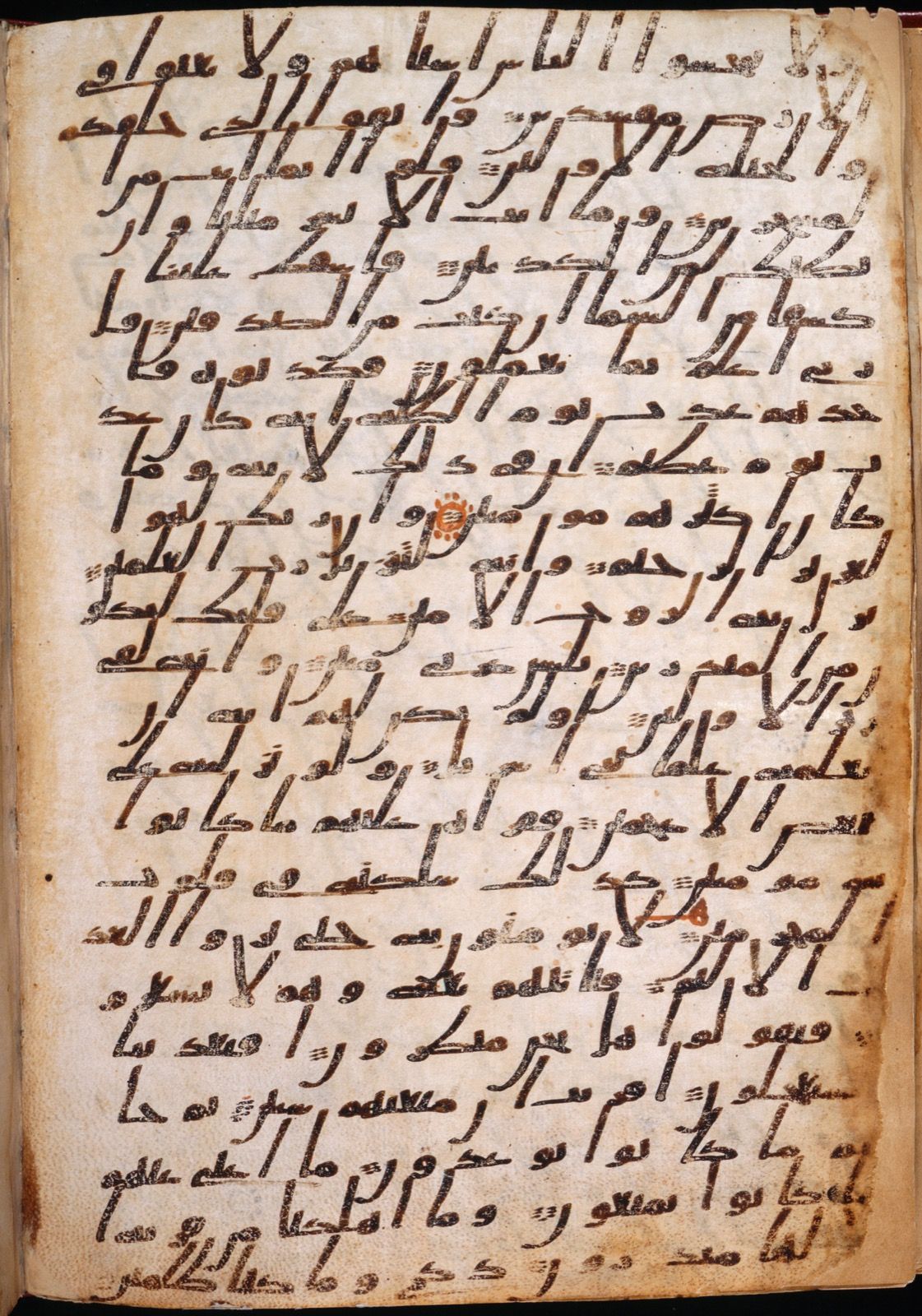
British Library Or. 2165, the Ma'il Quran, is an early Quran on vellum: 121 leaves, over two-thirds of the text, in a sloping Hijazi hand. The library's catalog dates it to the 8th century CE, Corpus Coranicum estimates 640 to 680 CE, and Yasin Dutton suggests copying in Syria, most probably in the Umayyad period. No radiocarbon date is reported.
Last reviewed:
Three dates, kept apart
The text's date: the tradition's view
610 to 650 CE (revelation 610 to 632 CE; the written standard text under Uthman about 650 CE, as David Thomas reports the Muslim account, and within Uthman's rule of 644 to 656 CE, which Abdullah Saeed gives as the time Muslim tradition holds the Quran was compiled; Yousef Wahb gives the 23 years of revelation, and Abu al-Qasim al-Khoei places the standard text under Uthman)
The text's date: critical scholars' view
610 to 705 CE (the strip starts at 610 CE, the date Muslim tradition gives for the first revelations, borrowed here because the scholarly sources used give no start year; it ends at the later of two views of the standard written text: Nicolai Sinai holds 650 CE or earlier as the default view, and Stephen Shoemaker argues for 685 to 705 CE, under Abd al-Malik, while allowing that much of the content may go back to Muhammad's preaching in the early seventh century)
This copy made
640 to 799 CE (three datings from handwriting and spelling: Corpus Coranicum, 640 to 680 CE; Yasin Dutton, the second half of the first century AH (the Islamic calendar), about 671 to 719 CE, computed here from Marijn van Putten's table; the British Library, the 8th century CE)
This copy found
29 April 1879 (bought by the British Museum from Greville John Chester, as a fly-leaf note records; the library's record does not say where it was found, and Corpus Coranicum lists al-Fustat without giving a reason)
What it is
British Library Or. 2165 is a Quran on vellum, a fine animal skin, bound as a codex, a book of pages rather than a roll.1 It has 121 leaves in three runs of consecutive leaves. They cover 7:40 to 9:96, 10:9 to 39:48, and 40:63 to 43:71, given as surah and verse (a surah is a chapter of the Quran).12 The library says this is over two-thirds of the text and one of the largest known fragments of an early Quran in the Ma'il script.3 Ma'il comes from the Arabic for "sloping". It is one of several early scripts called Hijazi, after the Hijaz, the region where they developed.3
How the copy was dated
No radiocarbon date for Or. 2165 appears in the sources used here, and the Corpus Coranicum entry leaves its carbon-dating field blank.4 The date comes from handwriting, called paleography, and from spelling, called orthography, and the sources give three different dates. For the methods, see how ancient texts are dated.
The British Library's catalog dates the codex to the 8th century CE and gives no method or reasons.1 Colin Baker of the library wrote in 2016 that the earliest Quran manuscripts were made in the mid-to-late seventh century. He added that Or. 2165 probably dates from the eighth century and was produced, as far as can be ascertained, in the Hijaz.3 The catalog lists a 2001 study of the first 61 leaves by Francois Deroche and Sergio Noja Noseda, which this site could not read.1
Corpus Coranicum, an online catalog of early Quran manuscripts edited by Michael Marx, dates it earlier, at 640 to 680 CE. It points to archaic spelling. On the first leaf, Noseda found 16 differences from the standard Cairo edition, all of them a missing alif, the letter that later copies use for a long a.4
Yasin Dutton judged the manuscript very like Paris Arabe 328a, since both follow the reading of the Syrian reader Ibn Amir and a verse-numbering pattern closest to that of Hims. He took both to be copied in Syria, most probably in the Umayyad period. His abstract names that period but gives no years.5 Marijn van Putten's table gives Dutton's date as the second half of the first century, citing page 66 of Dutton's article, which this site could not read. Counted in the Islamic calendar, that is about 671 to 719 CE (computed here).6
Intisar Rabb's abstract describes the manuscript as 1st/7th century and says her paper qualifies Dutton's conclusion about its reading.7
The text: its date and authorship
The date strip marks the Quran's text, not this codex. Both rows start at 610 CE, the year Muslim tradition gives for the first revelations. The scholars' row borrows that start because the sources used here give no start year. It ends at the later of the two views below, Nicolai Sinai's 650 CE or earlier and Stephen Shoemaker's 685 to 705 CE.289
The tradition's view
Two sources in this column are scholars' reports of what Muslims hold: Abdullah Saeed's encyclopedia article and David Thomas's comments in a university release. Saeed writes that the standard traditional Muslim view, Sunni and Shia alike, holds that God alone composed the Quran. On this view Muhammad passed it on without addition or alteration. Saeed adds that Muslim tradition holds it was compiled in the caliphate of Uthman (ruled 644 to 656 CE).10
Yousef Wahb of the Yaqeen Institute for Islamic Research writes that the Quran is God's speech and that God promised to protect it. He writes that it was revealed over 23 years and kept in memory and in writing, with oral transmission through memorization the primary method.11 The Sunni hadith collection of al-Bukhari (a hadith is a report of what Muhammad said or did) says the caliph Abu Bakr had the Quran gathered. It says the caliph Uthman later had copies sent to the provinces.121314
The Shia scholar Abu al-Qasim al-Khoei rejects the reports that credit the caliphs, Abu Bakr among them, with collecting the Quran, as inconsistent with one another. He holds that it existed as a complete written collection in Muhammad's lifetime and that Uthman united Muslims on one authoritative reading.1516 David Thomas reports Muslim tradition as dating the revelation 610 to 632 CE and the written text under Uthman about 650 CE.2
Scholars of the Quran's history: Sinai and Shoemaker
Nicolai Sinai, in a 2014 article, writes that Islamic tradition credits the standard consonantal text, the letters without vowel signs, to Uthman. In recent years, he writes, various scholars have espoused a conjectural dating of its codification to Abd al-Malik's time, or have at least taken the view that it stayed open to significant revision until about 700 CE. He holds that 650 CE or earlier, the traditional dating, should remain the default view, apart from some spelling features. That holds unless passages of a distinct style and vocabulary can be compellingly placed in the late seventh century.8
Stephen Shoemaker, in a book of 2022, argues that the Quran was composed and recomposed in oral transmission for decades after Muhammad's death. He adds that much of its content was presumably inspired by Muhammad's teachings. He holds that the canonical text took shape under Abd al-Malik (ruled 685 to 705 CE). As he reads them, the early manuscripts and their radiocarbon dates fit that view best, though he does not rule out earlier collections.9 He writes that most modern scholarship has placed uncomplicated confidence in the account of a text fixed under Uthman around 650 CE, and calls that confidence undeserved.9
The passages used here are about when and how the standard text took shape. They do not take up what Muslims hold about who composed it.
How it was found
The British Museum bought the codex in 1879 from Greville John Chester (1830 to 1892), as a note on a fly-leaf at the back records, dated 29 April 1879. Chester was a clergyman interested in archaeology, Egyptology, and natural history, who made many trips to Egypt and the Near East.13 The library says it is very likely he acquired the Quran in Egypt. Neither the library's record nor its blog says where the manuscript was found.3
Corpus Coranicum lists al-Fustat, which it elsewhere glosses as Old Cairo, as its provenance and gives no reason in the entry. It counts six leaves in Paris (Arabe 328 e) and two in Kuwait as parts of the same codex.417
What it shows, and what it does not
It shows how a large early Quran was laid out. It has 23 or 24 lines to a page, no vowel signs, and very few diacritical marks (the dots that tell similar letters apart). Verse ends are marked by dashes, and the red surah headings and ten-verse circles were added later.134 On Dutton's reading, its wording follows Ibn Amir, who died in 118 AH (736 CE).518
It does not show who commissioned it or where it was written. The library says the Hijaz, as far as can be ascertained, and Dutton suggests Syria.35 Rabb's abstract treats the location and number of its copyists as open questions.7 It does not settle between the three datings, and no radiocarbon result is reported to test them.
See also
Read next
Sources
- British Library. Or 2165: Qur'an (Archives and Manuscripts Catalogue record). British Library, the catalogue record. Accessed 2026-11-06.
- University of Birmingham. Birmingham Qur'an manuscript dated among the oldest in the world. University of Birmingham, 2015. Accessed 2026-10-29.
- Colin F. Baker (British Library, Head of Middle Eastern and Central Asian Collections). The British Library's oldest Qur'an manuscript now online. British Library, Asian and African studies blog, 7 April 2016 (Internet Archive copy), 2016, the whole post. Accessed 2026-11-06.
- Michael Marx (with Salome Beridze), Manuscripta Coranica, Corpus Coranicum. The British Library: Or. 2165 (catalogue entry). Corpus Coranicum, CC BY 4.0, the header fields and the catalogue entry. Accessed 2026-11-06.
- Yasin Dutton. Some Notes on the British Library's 'Oldest Qur'an Manuscript' (Or. 2165). Journal of Qur'anic Studies 6, no. 1 (April 2004), pp. 43 to 71, Edinburgh University Press, 2004, abstract only. Accessed 2026-11-06.
- Marijn van Putten. 'The Grace of God' as Evidence for a Written Uthmanic Archetype: The Importance of Shared Orthographic Idiosyncrasies. Bulletin of the School of Oriental and African Studies 82, no. 2 (June 2019), pp. 271 to 288, Cambridge University Press (open access, CC BY 4.0), 2019, abstract, the passage on Dutton, and the section 'The manuscripts' (pp. 271 to 288). Accessed 2026-11-06.
- Intisar A. Rabb. Non-Canonical Readings of the Qur'an: Recognition and Authenticity. Journal of Qur'anic Studies 8 (2006), beginning on p. 84 (Harvard Law School faculty bibliography page, abstract), 2006, abstract only. Accessed 2026-11-06.
- Nicolai Sinai. When did the consonantal skeleton of the Quran reach closure? Part II. Bulletin of the School of Oriental and African Studies 77, no. 3, 2014, abstract. Accessed 2026-10-29.
- Stephen J. Shoemaker. Creating the Qur'an: A Historical-Critical Study. University of California Press (Luminos open access), 2022, introduction (radiocarbon summary; Abd al-Malik, p. 13; pp. 3 and 14 to 15), chapter 1 (p. 17 and pp. 25 to 30), chapter 2 (p. 43), the radiocarbon chapter (pp. 73 to 86), and p. 238 (printed page numbers). Accessed 2026-10-29.
- Abdullah Saeed. Qur'an: Tradition of Scholarship and Interpretation. Encyclopedia of Religion, second edition (Macmillan Reference USA), via Encyclopedia.com, 2005. Accessed 2026-10-29.
- Yousef Wahb. How the Quran Was Preserved During the Prophet's Time: Mechanisms of Oral and Written Transmission. Yaqeen Institute for Islamic Research, 2022. Accessed 2026-10-28.
- Muhammad al-Bukhari (compiler). Sahih al-Bukhari 4986, English translation. Hadith Unlocked, hadith 4986. Accessed 2026-10-29.
- Muhammad al-Bukhari (compiler). Sahih al-Bukhari 4987, English translation. Hadith Unlocked, hadith 4987. Accessed 2026-10-29.
- Mohammad Hashim Kamali. Hadith. Encyclopedia of Religion, second edition (Macmillan Reference USA), via Encyclopedia.com, 2005. Accessed 2026-10-29.
- Abu al-Qasim al-Khoei, translated by Abdulaziz A. Sachedina. The Prolegomena to the Qur'an, chapter 8: The Collection of the Qur'an. Oxford University Press (1998); online at Al-Islam.org, 1998, chapter 8. Accessed 2026-10-29.
- Al-Islam.org (Ahlul Bayt Digital Islamic Library Project). Sayyid Abu al-Qasim al-Khoei (biographical page, Shia Scholars). Al-Islam.org, the biography paragraph on the person page. Accessed 2026-11-06.
- Michael Marx, Manuscripta Coranica, Corpus Coranicum. The Khalili Collections: KFQ 60 (catalogue entry). Corpus Coranicum, CC BY 4.0, the header fields and the catalogue entry. Accessed 2026-11-06.
- Yousef Wahb. Can the Quran Be Recited in Different Ways? The Meaning and Wisdom of Qiraat. Yaqeen Institute for Islamic Research, 2022. Accessed 2026-10-29.