
Writings: Hinduism
The Khoh charter of Maharaja Sarvanatha
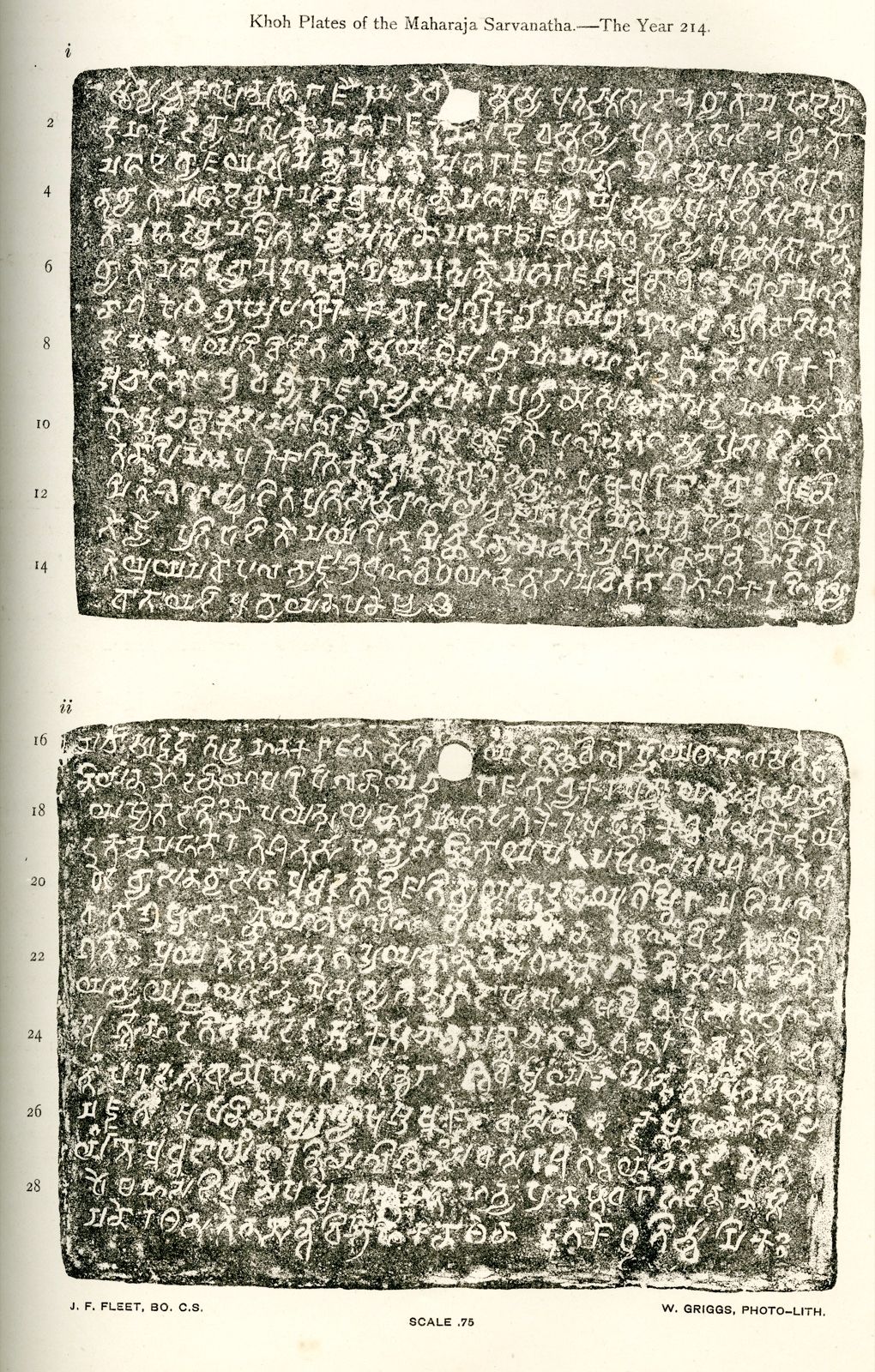
The Khoh charter is a land grant on two copper plates, dated year 214 of an unnamed era. Fleet, who edited it in 1888, printed 533 to 534 CE on the Gupta era and weighed 463 to 464 CE on Cunningham's Kalachuri starting point. It cites the Mahabharata by name. No source used says where the plates are now.
Last reviewed:
Three dates, kept apart
The text's date: the tradition's view
The sources used here give no year for the epic's composition, which they credit to the sage Vyasa. ISKCON Educational Services, a Vaishnava source, places the war the epic tells of at the end of the Dvapara Yuga, the age before the Kali Yuga, which it says began some 5,000 years ago (about 3000 BCE, computed here from 2026). No statement on the epic's date or authorship from a Shaiva or Shakta tradition was found.
The text's date: critical scholars' view
500 BCE to 400 CE (Alf Hiltebeitel, for the composition of the epic as a whole; Hopkins in 1901: the whole epic, generally speaking, may date to 200 to 400 CE, leaving out later additions)
This copy made
533 to 534 CE (year 214 on the Gupta reading, which John Faithfull Fleet printed in 1888 and R. R. Halder defended; the charter names no era; on Cunningham's Kalachuri starting point Fleet gives 463 to 464 CE, and he wrote that a starting point 25 or 30 years later would suit the records better)
This copy found
by 1879, when Cunningham published a translation of the plates; found somewhere in the valley near the village of Khoh, in Nagaudh State, central India; the finder and the year of the find are not recorded
What it is
The Khoh charter is a land grant cut in Sanskrit on two copper plates. A charter is a ruler's written order. This one comes from Maharaja Sarvanatha (maharaja is literally "great king"), who issued his charters from a place called Uchchakalpa.121 It records his approval of a transfer of two villages, Vyaghrapallika and Kacharapallika. They were given for the worship of the goddess Pishtapurika, and for repairs, at a temple at the town of Manapura.1
The charter ends with verses that warn against taking such a gift back. It says they are from the Mahabharata, a very long Sanskrit epic, and credits them to the sage Vyasa. It calls the work, or a part of it, the "Satasahasri-Samhita" (written here without accents).31 The ring and seal that once joined the plates are no longer with them.1
How the copy was dated
The year is written out in words as two hundred and fourteen, on the sixth day of the month of Pausha, which falls in December and January. No era is named.31 An era is a count of years from a fixed starting point. John Faithfull Fleet, who edited the plates in 1888, printed the equivalent as 533 to 534 CE. That is the Gupta reading, the count used in the records of the early Gupta kings. Cunningham, who published a translation of the plates in 1879, assumed it, and Fleet at first agreed.1
Fleet later weighed the Kalachuri era, a count named for a dynasty of central India, if it could be shown to have existed so early. On Cunningham's starting point, 249 to 250 CE, he worked out that year 214 would be 463 to 464 CE. He wrote that the Kalachuri era with that starting point would suit the records almost as well as the Gupta era. A starting point about 25 or 30 years later, he added, would suit them much better.1
Fleet also wrote that Kielhorn had determined that all ten Kalachuri-era dates Cunningham gave would fit a starting point of 248 to 249 CE, if only three of them were taken as expired, or completed, years. But the family's own dates give no details to calculate from, he noted, so the question could not then be decided that way.1
R. R. Halder, editing another grant of the same king, gives year 214 as 533 to 534 CE. He reports that Kielhorn was inclined to the Kalachuri era and that Gaurishankar H. Ojha held to the Gupta era, and he agrees with Ojha. A pillar inscription at Bhumara, he writes, makes Sarvanatha and a king named Hastin contemporaries, and Hastin's inscription refers to the Gupta era.2 For the methods, see how ancient texts are dated.
The text: its date and authorship
The date strip marks the Mahabharata, the work the charter names and quotes.
A Vaishnava account, with a scholar's report of the tradition
ISKCON Educational Services, a Vaishnava source (Vaishnavas worship Vishnu and his incarnations, especially Krishna and Rama),4 holds that the sage Vyasa originally composed the Mahabharata and that it was handed down over thousands of years.5
A second page places the war the epic tells of at the end of the Dvapara Yuga, one of four ages of the world, and says the Kali Yuga, the next age, began some 5,000 years ago.6 Alf Hiltebeitel reports that Vyasa is the epic's reputed author.7 No page gives a year for the composition, and the sources used here include no statement on the epic's date or authorship from a Shaiva or Shakta tradition (centered on Shiva and on the goddess Shakti).8
Scholars of the epic
Alf Hiltebeitel writes, in an entry of 1987, that the epic's composition seems to have been carried out between about 500 BCE and 400 CE, by authors who probably drew on older bardic traditions. He adds that it is said to hold 100,000 verses, although no known recension reaches that number.7
E. Washburn Hopkins argued in 1901 that the epic, for the most part as it now stands, is no later than the fourth or fifth century CE, since inscriptions dated not much later refer to it. He wrote that the whole epic, generally speaking, may date to 200 to 400 CE, and added that this leaves out later additions and recastings.9
How it was found
The plates were found somewhere in the valley near the village of Khoh, in the Baghelkhand division of central India. Khoh lies about three miles south-west of Uchahara, the capital of Nagaudh State in Fleet's day. Fleet names no finder and no year.1 Cunningham first brought them to notice in 1879.13
Fleet obtained the plates for examination from Cunningham's possession.1 None of the sources used, the DHARMA record included, names a holder.3
What it shows, and what it does not
Whatever its era, the charter shows that a king's office in central India could cite verses as said in the Mahabharata. It credits them to Vyasa, son of Parashara and arranger of the Vedas.1 Read word for word, the charter's name for the work means a hundred thousand (sata is hundred and sahasra is thousand, a reading made here). Hiltebeitel says the epic is said to hold that many verses, though Fleet's index leaves open whether the name means the whole poem or a section.71
It does not show that the Mahabharata of that time matched the text now read. The charter quotes only verses on land gifts, and this site did not check them against a printed text. And the date rests on an era the charter does not name. On Cunningham's starting point, the two readings differ by about 70 years (computed here), and by less on a later one.1
See also
Read next
Sources
- John Faithfull Fleet. Corpus Inscriptionum Indicarum, vol. 3: Inscriptions of the Early Gupta Kings and Their Successors. Superintendent of Government Printing, Calcutta (1888); the saved text is the Indological Book House reprint of 1963, as scanned by the Internet Archive, 1888, introduction pp. 8 to 10 (the Gupta era and the Kalachuri alternative for the Uchchakalpa dates); p. 98, note 5 (the verses on land grants and their attributions); Nos. 28 to 31, pp. 125 to 139 (the Khoh plates, with No. 31, the year 214, on pp. 135 to 139). Accessed 2026-11-06.
- R. R. Halder. The Sohawal Copper-plate Inscription of Maharaja Sarvanatha, the Year 191 (No. 21). Epigraphia Indica, vol. 19, Archaeological Survey of India; text via jainqq.org, printed pp. 127 to 129 (the introduction and the editor's note on the era). Accessed 2026-11-06.
- Daniel Balogh (digital edition); DHARMA project. Khoh Charter 2 of Sarvanatha, year 214 (DHARMA_INSSiddham00088). DHARMA (Development of Digital Resources for the Study of Indic Languages and Cultures), the Sanskrit edition, lines 1 to 29; the bibliography. Accessed 2026-11-06.
- ISKCON Educational Services. Heart of Hinduism: Smriti: The Mahabharata. ISKCON Educational Services. Accessed 2026-10-29.
- ISKCON Educational Services. Heart of Hinduism: The Tradition's Own Version. ISKCON Educational Services. Accessed 2026-11-06.
- Alf Hiltebeitel. Mahabharata. Encyclopedia of Religion, second edition (Macmillan Reference USA), via Encyclopedia.com, 2005. Accessed 2026-11-06.
- Sivaya Subramuniyaswami. Dancing with Siva, Hinduism's Contemporary Catechism, sixth edition, "What Are Hinduism's Principal Sects?". Himalayan Academy, 2003, chapter 1, sloka 6. Accessed 2026-10-28.
- E. Washburn Hopkins. The Great Epic of India: Its Character and Origin. Charles Scribner's Sons, New York (Yale Bicentennial Publications), 1901, chapter on the date of the epic, pp. 386 to 389. Accessed 2026-11-06.